Radon Mitigation System Installation in Omaha NE
Radon mitigation system installation in Omaha NE adds a pipe and a fan to your home. We fit the system to your foundation. Then we label it, show you the gauge and set up your retest.
Licensed and insuredMany years serving the greater Omaha area
 Action level4.0 pCi/L
When you need radon mitigation, and when a test comes first
A test result decides this. Nothing else does.
The EPA says to fix your home at 4.0 pCi/L or higher, and says even levels below 4.0 carry some risk. It does not recommend sealing alone, since sealing has not been shown to lower radon much or reliably (EPA Home Buyer's and Seller's Guide). In most homes, a vent pipe and fan do the real work.
No test yet? Start with our radon testing and inspection page. Already have a number? Send it with the form and we will take it from there.
System types for basements, slabs and crawl spaces
The EPA lists several ways to pull radon out of the soil. We pick the one that fits how your house is built.
Sub-slab suction
A pipe goes through the basement or slab floor into the gravel or soil below. The EPA calls it the most common and usually the most reliable method (EPA).
Sump-hole suction
If your sump pit has a sealed, gasketed lid, the pit can serve as the suction point. This is common in Omaha basements with a drain tile loop.
Drain-tile suction
Suction pulls through the drain tile around the footing. It works well when the tile loop is complete.
Block-wall suction
Hollow block walls can hold radon. A suction point in the wall, often paired with sub-slab suction, pulls it out.
Crawl space membrane
A heavy plastic sheet covers the dirt, and a pipe and fan draw radon from under it. The EPA calls this the most effective crawl space method.
Passive-to-active upgrade
Many newer homes have a stub pipe from construction. Adding a fan can turn it into an active system.
Need more on basements? See our guide to basement radon reduction systems in Omaha.
Residential radon mitigation, step by step
- Site visit. We look at the slab, walls, sump pit, floor drains and any finished areas so we can choose the suction point and the pipe route.
- Written bid. You see the system type, fan location, pipe route and testing plan in writing.
- Suction point. We core through the slab, remove a small pocket of soil or gravel and set the pipe.
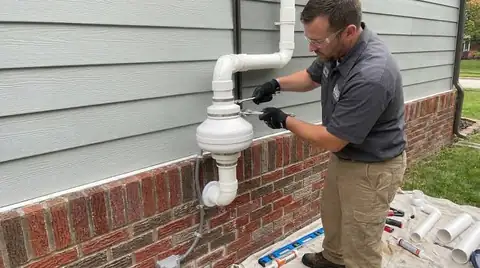
- Pipe and fan. The pipe runs to the attic, garage or outside wall. The fan mounts outside the living space, and the exhaust ends above the roof and away from windows.
- Seal and gauge. We seal the pit, the slab edges and openings near the suction point, then fit a warning gauge you can read.
- Label and test plan. We label the pipe. A short-term test follows after the fan runs at least 24 hours and within 30 days (ANSI/AARST SGM-SF).
Ready to schedule a site visit?
What changes the price
Every bid is for one house. These items move it the most:
- Foundation type, such as slab, basement, crawl space or a mix
- How easily air moves under the slab
- Pipe length and whether it runs inside a finished wall
- Sump pit work and sealing
- Fan size and whether the exhaust can go through the roof or the wall
For context, the EPA's cost analysis uses about $1,826 for a soil depressurization install, in 2023 dollars (EPA). An older EPA page says a typical home costs about $500 to $2,500 (EPA Physician's Guide). See the full cost of radon mitigation in Nebraska.
What can go wrong, and how we prevent it
Weak suction
Tight soil or a poor suction point can leave the number high. Adding a second suction point can help.
Pipe too close to a window
Exhaust should end above the roof and away from openings. Nebraska sets this for new homes at least 12 inches above the roof (Neb. Rev. Stat. 76-3504).
No gauge or label
A warning gauge and clear labels let you spot trouble and let the next owner know what the pipe is.
Skipped retest
Without a test after the install, you do not know it works. We build it into the plan.
Licenses, permits and who may do the work
Nebraska requires a state license for anyone who installs a radon system for pay (Nebraska DHHS). Check any company in the state license lookup. In Iowa, mitigation specialists need an Iowa credential (Iowa HHS). We are licensed and insured. Cities set their own permit rules, and a new circuit for the fan can need an electrical permit. Your installer should handle it. Details are on our permits and codes page, and our guide to radon mitigation contractors in Omaha NE shows how to compare local companies.
Back to the radon mitigation Omaha NE home page.
Questions people ask us
How do I know I need residential radon mitigation?
The EPA says to fix a home when a long-term test, or the average of two short-term tests, is 4.0 pCi/L or higher, and to consider fixing between 2 and 4 pCi/L (EPA Consumer's Guide).
Where does the fan go?
The fan goes outside the living space: in the attic, the garage or on the outside wall. The pipe ends above the roofline and away from windows.
How much radon can a system remove?
The EPA lists 50 to 99 percent for active sub-slab suction, and says radon in most homes can be brought to 2 pCi/L or lower (EPA).
Will the system make noise or raise my bills?
A fan hums softly. The EPA's cost analysis uses about $206 a year for operating costs (EPA analysis).
Do I need a permit?
Permit rules differ by city. A new circuit for the fan is the usual trigger. We explain the local steps on our permits and codes page.
Do you work in Iowa?
Yes, in Council Bluffs and nearby. Iowa requires its own credential for mitigation specialists, and that includes out-of-state companies (IAC 641-44).