Basement guide
Basement Radon Reduction Systems in Omaha NE
Basement radon reduction systems in Omaha NE pull radon from under the floor and walls. They vent it above the roof. This guide covers the types, what a finished basement changes and what to expect.
Licensed and insuredMany years serving the greater Omaha area
 Action level4.0 pCi/L
Four ways to treat a basement
Sub-slab suction
Pipe through the floor into the gravel under it.
Drain-tile suction
Suction through the perimeter drain loop.
Sump-hole suction
The sealed sump pit acts as the suction point.
Block-wall suction
Pulls from hollow block cores.
The EPA lists these as basement methods (EPA Consumer's Guide). Many homes need one suction point, and tight soils may need two.
Finished, partly finished or crawl space
| Basement type | What to expect |
|---|---|
| Unfinished | Easiest route. The pipe often runs along a wall. |
| Finished | Route through a closet, chase or utility room. We plan around finishes. |
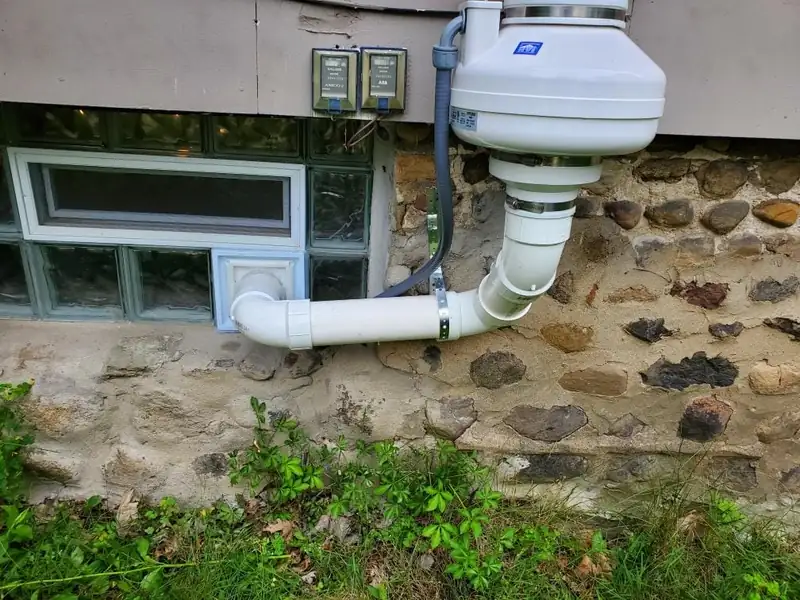
| Walkout | Exhaust and fan can often exit through the outside wall. |
| Crawl space | Heavy plastic sheet over the soil, with a pipe and fan. The EPA calls it the most effective crawl space method. |
Get a basement radon plan
What the ground is like around Omaha
The USGS map of the greater Omaha area shows loess (windblown silt) capping the high ground between streams, with glacial till mostly buried and river sediment in the valleys (USGS MF-2391). Loess is fine-grained, so air may move slowly through it. That is one reason we test the slab with a quick suction check before we choose the pipe route. See also our installation page.
Before you finish a basement
Test first. A system is easier to plan before the walls go up. Ask the builder to leave a path for a pipe. Nebraska requires a passive pipe and an attic electrical box in new homes under the radon-resistant rule (Neb. Rev. Stat. 76-3504), which makes a later fan an easy add. For costs see radon mitigation cost in Nebraska, or go back to the home page.
Questions people ask us
What is the best basement radon reduction system?
Sub-slab suction is the most common and usually the most reliable method, as the EPA describes (EPA Consumer's Guide). Your basement may need another type or a combination.
Can a finished basement get a system?
Yes. The pipe can run in a closet, a utility chase or outside the house. A finished space changes the route and the price.
What about a sump pit?
A sealed, gasketed lid keeps room air from mixing with soil air, and the pit can serve as a suction point.
Do block walls need extra work?
Hollow block walls can carry radon. A wall suction point can be added to the system.
Will sealing cracks fix radon?
Sealing alone is not recommended by the EPA (EPA). Sealing helps a system work better, but it is not the fix.
Is the soil in Omaha a factor?
The USGS describes loess, a windblown silt, covering the uplands in the greater Omaha area (USGS map MF-2391). Soil type changes how air moves, so we test the slab before we design.